Dear Friend of Hartford Street Zen Center,
Someone once asked our founder, Issan Dorsey, what it was we were doing in starting a Zen Center at Hartford Street. He replied, “We’re establishing a Buddhist presence in the Castro.” At that time, the early eighties, when someone said the Castro, it was immediately assumed that one was referring to the*LGBTQQI&A community. I’m sure that this was true in great part in Issan’s statement, since he felt as a gay man a special ministry toward the gay community.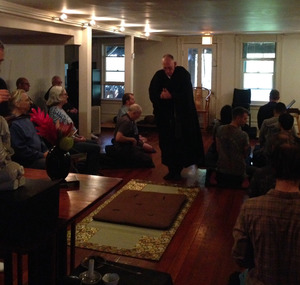
Nowadays, even though the Castro may still be predominantly *LGBTQQI&A, the demographic is shifting. In regards to Buddhism this is beside the point. The Buddha Way is open to all who wish to explore this path that plumbs the depths of what it means to be truly human. So here at Hartford Street Zen Center we’re still working on establishing a Buddhist presence in the Castro, still trying to create a place where we and our neighbors can find out what Buddhist practice means in our lives. We’ve been doing this for almost thirty-five years.
This endeavor only continues because of your ongoing support, for which you will always have our gratitude. Over the years we have received both financial support and encouragement from people around the world. It warms my heart when I hear of the ways in which our effort has touched the lives of so many, particularly young LGBTQQI&A people, who may be struggling with their place in their family or community.
Your support not only assists us in maintaining a regular meditation schedule of morning and evening zazen, but also enables us to offer a weekly study hour as well as providing a meeting space for an HIV meditation group and three Meditation in Recovery groups. Please consider making a donation or becoming a member to help us continue to establish a Buddhist presence in the Castro.
In Peace,
Tanzen David Bullock,
President, Board of Directors
Hartford Street Zen Center

 for our full moon ceremony I mislabeled this month the Sturgeon or the green corn moon… That is incorrect and in late August! This Saturday is a second full Moon of July Celebration and something we use in a common phrase… “